eBay vs TCGPlayer: Where Should You Actually Sell Pokémon Cards?
If you’ve been flipping Pokémon cards for any length of time, you’ve probably sold on both eBay and TCGPlayer. And you’ve probably noticed that the same card can fetch different prices on each platform — sometimes by a lot. That gap isn’t random. It exists because the two platforms serve different buyers, operate under different […]

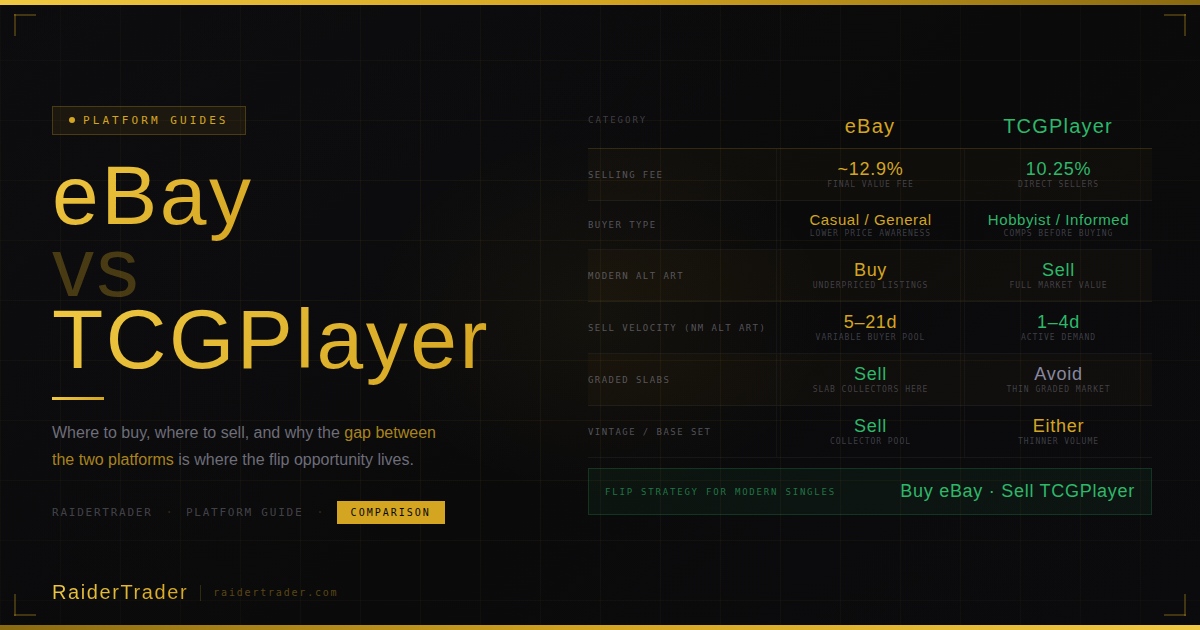
If you’ve been flipping Pokémon cards for any length of time, you’ve probably sold on both eBay and TCGPlayer. And you’ve probably noticed that the same card can fetch different prices on each platform — sometimes by a lot. That gap isn’t random. It exists because the two platforms serve different buyers, operate under different fee structures, and reward different seller behaviors.
This post breaks down both platforms honestly. Not which one is “better” — that depends entirely on what you’re trying to do — but what each one is actually good for, where each one costs you money you might not have noticed, and why the spread between the two is one of the most reliable patterns in the entire hobby market.
Two Different Marketplaces, Two Different Buyers
The most important thing to understand about eBay and TCGPlayer isn’t the fees. It’s the buyer intent.
eBay buyers are general consumers. They shop for everything on eBay — clothes, electronics, collectibles, Pokémon cards. Most of them have a rough idea of what a card is worth, but they’re not running TCGPlayer comps before every purchase. They’re making decisions based on what looks like a good deal relative to their own (often imprecise) sense of market value. This is why underpriced cards get listed and sold on eBay without the seller realizing they’ve left money on the table.
TCGPlayer buyers are hobbyists. Almost everyone shopping on TCGPlayer knows exactly what they’re looking for, has checked the market price before clicking, and is comparing your listing to every other listing for the same card in the same condition. They are price-aware, condition-conscious, and comparison-shopping in real time. You cannot slip an LP card past a TCGPlayer buyer at NM prices.
eBay has casual sellers and casual buyers. TCGPlayer has informed sellers and very informed buyers. That asymmetry is where the arbitrage opportunity lives.
This fundamental difference in buyer intent shapes everything else about the two platforms — the prices cards trade at, how long they take to sell, and how you need to approach each one as either a buyer or a seller.
The Fee Comparison
Fees are where most comparisons between these platforms start and stop. They matter, but the full picture is more nuanced than just the headline percentage.
The fee difference between the two platforms is real but small — about 2.5–3% in TCGPlayer’s favour on most transactions. Over hundreds of flips that adds up, but it’s not the main reason to prefer one platform over the other for selling. The bigger driver is where your card will sell faster and for more money, which varies by card type and price point.
TCGPlayer Direct lets you send your inventory to TCGPlayer’s warehouse and they handle fulfillment. The fee structure is different (and higher), but for high-volume sellers it removes the friction of packing and shipping every individual order. For flippers doing 5–20 cards a month, it’s usually not worth the complexity.
Where Cards Actually Sell for More
This is the question that actually matters for flipping — not which platform has lower fees, but which one will net you more money on the specific card you’re trying to sell.
The answer is almost always TCGPlayer for selling, and the reason comes back to buyer intent. TCGPlayer buyers are shopping with a target price in mind. If you list at or just below the market price, serious buyers will purchase quickly. eBay buyers, by contrast, are often browsing without a specific price anchor — which means you’re competing on presentation as much as price.
When eBay gets you more
There are specific situations where eBay outperforms TCGPlayer as a selling platform:
- Graded cards (PSA, BGS, CGC slabs). TCGPlayer’s market is built for raw cards. Graded copies sell better on eBay where collectors specifically hunt slabs, often paying above any TCGPlayer equivalent.
- Sealed product. Booster boxes, ETBs, and tins trade heavily on eBay. TCGPlayer has a sealed section but buyer volume is much thinner.
- Very old or niche cards. Vintage Pokémon — Base Set, Jungle, Fossil, early Japanese prints — tend to have a wider buyer pool on eBay. Collectors who want these aren’t necessarily TCGPlayer users.
- Auction format for highly desirable cards. If you have a Charizard VSTAR in pristine condition during a period of high demand, an eBay auction can push the price above TCGPlayer market. This takes timing and nerve and doesn’t always work.
When TCGPlayer gets you more
- Modern standard-legal cards. Alt Arts, SIRs, and competitive staples from recent sets. These buyers are on TCGPlayer already.
- Near Mint singles priced $10–$200. This is the sweet spot where TCGPlayer’s buyer pool is deepest and most active.
- Anything a competitive player might need. Tournament-relevant cards sell in days on TCGPlayer because players need them for their decks before the next event.
- Volume selling of smaller cards. Listing 30 cards in one session is faster on TCGPlayer’s inventory system than creating 30 individual eBay listings.
Sell Velocity: The Number Most People Ignore
Most comparison posts focus entirely on fees and miss the thing that matters more for flippers: how fast the card actually sells. A card that sells in 2 days on TCGPlayer and takes 3 weeks on eBay isn’t just more convenient — it changes your capital velocity entirely.
If you can flip the same $50 into $60 every two days instead of every three weeks, the difference in annual return is massive. This is why serious flippers prioritise TCGPlayer for selling modern singles — not because the fees are lower, but because the buyer pool is larger and more active for exactly the cards they’re selling.
The Spread Between Platforms Is the Opportunity
Here’s where flipping strategy comes in. Because eBay and TCGPlayer serve different buyer types with different price awareness, the same card consistently lists cheaper on eBay than it trades for on TCGPlayer. This isn’t a glitch — it’s a structural feature of how the two platforms work.
eBay sellers are often casual collectors, parents clearing out binder space, or players who pulled something nice and just want to move it quickly. They price based on a quick eBay search, not TCGPlayer comps. They may not even know TCGPlayer exists. A card worth $49 on TCGPlayer might get listed on eBay at $27 because that’s what similar eBay listings show — and those eBay listings are also underpriced relative to actual market value.
eBay prices anchor to other eBay prices. TCGPlayer prices anchor to actual market data. That anchoring difference is why the gap exists and why it persists.
The flip strategy is exactly what it sounds like: buy on eBay where information asymmetry creates underpriced listings, sell on TCGPlayer where informed buyers pay actual market value. The RaiderTrader scanner automates the research side of this — it monitors eBay BIN listings every 6 hours and surfaces cards where the gap between the eBay price and TCGPlayer market price justifies the buy after fees.
Practical Guide: When to Use Each Platform
Listing Tips for Each Platform
Listing on eBay
- Use the full card name in the title. Include the set name, card number, and condition. “Charizard VSTAR Silver Tempest 018/195 Near Mint” will rank better in search and attract buyers who know exactly what they want.
- Take angled light-source photos. Buyers who care about condition — the buyers who pay more — want to see the corners and surface clearly. Flat, straight-on shots look like you’re hiding something.
- Set Buy It Now, not auction. Unless you genuinely believe you have a card that will auction above market (you usually don’t), BIN gives you a predictable price and faster resolution.
- Price against TCGPlayer, not other eBay listings. Other eBay listings are already underpriced relative to actual market value. If you price against them, you’re accepting a discount you don’t have to take.
- Offer free shipping on cards over $15. Buyers factor in total cost. Cards priced at $18 with free shipping convert better than $16 plus $3 shipping, even though the buyer pays the same.
Listing on TCGPlayer
- Price just below the lowest NM listing, not at it. TCGPlayer sorts by price. If you’re $0.50 below the next seller, you’re at the top of the results and you’ll sell first.
- Grade accurately. TCGPlayer buyers know condition well. LP cards listed as NM get returned — the return process is straightforward for buyers, and it costs you time, shipping, and feedback.
- Check the sales history tab. Before you list, look at how many copies have sold in the past 30 days and at what price. This tells you whether your card will move fast or sit.
- List in batches. The TCGPlayer seller interface is efficient for bulk listing. Set aside 30 minutes and list everything you have rather than doing it one card at a time.
- Don’t undercut below market more than 5%. Aggressive underpricing on TCGPlayer compresses the market for everyone, including your future listings. Price competitively, not desperately.
The Bottom Line
For flipping modern Pokémon singles — which is what this site is built around — the optimal strategy is simple: buy on eBay, sell on TCGPlayer. Buy from casual sellers who price without full market data. Sell to informed buyers who pay actual market value. The fee difference is almost irrelevant compared to the spread between the two platforms.
The exceptions are real: graded cards, sealed product, and vintage singles all belong on eBay as the sell destination. But for the Alt Arts, SIRs, and competitive staples that make up the bulk of liquid flip opportunities, TCGPlayer is where you exit.
The RaiderTrader scanner is built entirely on this logic. It monitors eBay every six hours looking for the gap — cards where eBay prices are materially below TCGPlayer market price — and scores each opportunity by margin, sell velocity, price trend, and seller trust. The Pro feed surfaces every qualifying deal in real time. Free members see the top three from each scan.
If you want to understand how the scoring works before you sign up for anything, read the Flip Score explainer. It walks through the formula in full — no black boxes.