Most people who browse eBay for Pokémon cards are guessing. They see something that looks cheap, compare it to the first price they find, and go with their gut. Sometimes it works out. Usually it doesn’t — not consistently, anyway.
A smaller group of people do this the same way every single time. They check the same three numbers, in the same order, before they touch anything. They’re not smarter. They’re just more systematic.
This post lays out that process in full. You don’t need any paid tools or special software to do this. You need eBay, TCGPlayer, and about five minutes per card. Once you’ve done it a few dozen times, it starts to feel automatic.
Why the Price Gap Exists in the First Place
Before we get into the how, it helps to understand the why — because once you get it, you’ll see these gaps everywhere.
Most people who sell Pokémon cards on eBay aren’t dealers. They’re collectors clearing out a binder, parents finding cards in a kid’s room, or hobbyists who pulled something nice and figured they’d sell it. They price by feel. Maybe they search one sold listing, round to the nearest five dollars, and list it. Maybe they don’t even do that.
TCGPlayer, on the other hand, is where serious buyers shop. The market price on TCGPlayer reflects what informed buyers are actually willing to pay. That gap between an eBay seller’s asking price and the TCGPlayer market price is the opportunity.
The seller doesn’t know what the buyer knows. That information gap is where the money is.
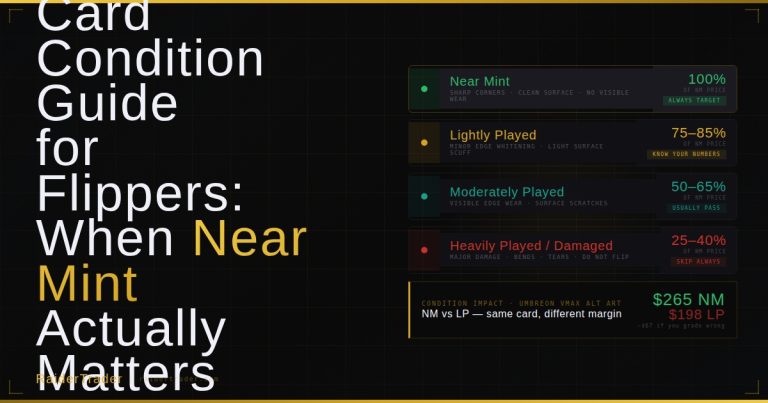
The gap is most reliable on specific types of cards — Alt Arts, Special Illustration Rares, and cards that see competitive play. These cards have the biggest difference between casual seller knowledge and actual market value. A casual seller might price an Umbreon VMAX Alt Art at $160. A buyer who checks TCGPlayer knows it’s trading at $265.
Common cards, bulk, and widely-recognized cards like base set Charizard don’t work as well — everyone knows what those are worth. The edge is in the cards where knowledge matters.
The Three Numbers You Check Before Every Flip
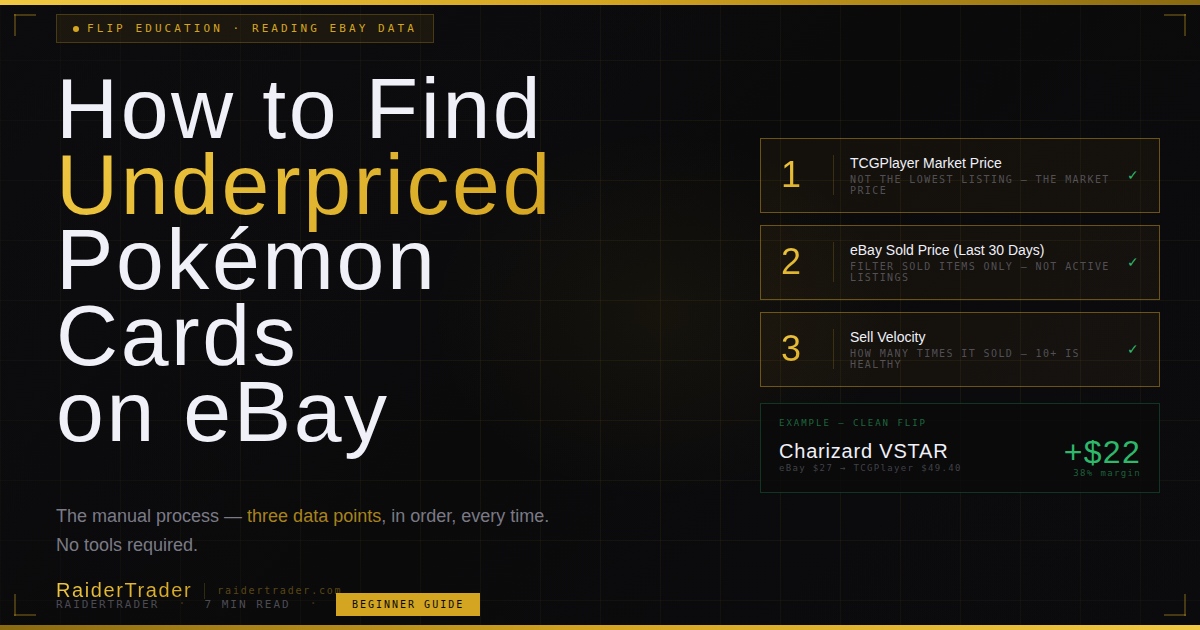
Here’s the core habit. Before you buy anything, you need three numbers. Not two. All three.
1. TCGPlayer Market Price
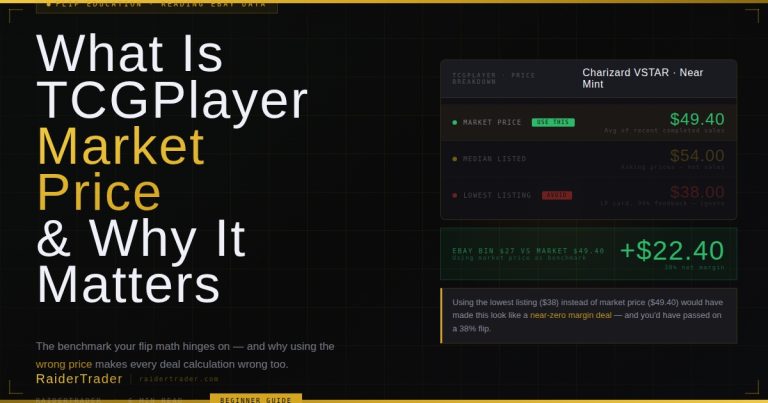
Go to TCGPlayer and find the card. Look at the TCGPlayer market price — not the lowest listing. The lowest listing is often an outlier. The market price is calculated from actual recent sales and gives you a realistic benchmark for what the card is trading at right now.
2. eBay Sold Price (Last 30 Days)
Go to eBay, search the card, and filter by Sold Items. Look at what buyers actually paid in the last 30 days — not what sellers are asking for right now. Asking prices are wishful thinking. Sold prices are reality. You want the median of recent sales, ignoring the outliers at the very top and bottom.
3. Sell Velocity
While you’re looking at those sold listings, count them. How many copies sold in the last 30 days? This tells you how fast you can expect to exit if you buy. Ten or more sales is healthy. Under four is a yellow flag. A great margin means nothing if your money is locked up for two months waiting for a buyer.
How to Run the Search on eBay
Here’s exactly what to do, in order:
-
1Search with the full card name + set name + conditionExample: “Charizard VSTAR Silver Tempest NM”. Being specific filters out damaged copies and wrong sets that will skew your data.
-
2Click “Sold Items” in the left sidebarThis is the most important step. Active listings show asking prices — only sold items show you what buyers actually paid. Never benchmark off asking prices.
-
3Set the date range to the last 30 daysOlder sales don’t reflect today’s market. A card that sold for $80 six months ago might be worth $40 or $120 today. Keep it recent.
-
4Look at the middle cluster — ignore the outliersThe very top and bottom results are usually flukes — a desperate seller or an oblivious one. The truth lives in the middle 60–70% of results.
-
5Count the results and compare to TCGPlayer market priceThe result count is your sell velocity. The median sold price versus TCGPlayer’s market price is your spread. If the spread is 20%+ after fees — you might have something.
-
6Run the fee math before you commiteBay takes roughly 13% when you sell (final value fee + payment processing). Factor that out of your expected selling price. A $22.40 spread becomes about $18–19 after fees. Still good — but you need to know the real number.
Stick to Buy It Now listings when you’re looking to buy. Auctions introduce variance — you might win at a great price or get caught in a bidding war and overpay. BIN listings are predictable and faster to close.
What Makes a Card Actually Worth Flipping
Not every price gap is worth chasing. Here’s what tends to work and what doesn’t.
One more thing worth knowing: a margin of 20% after fees is your floor, not your target. Below that, you’re putting in real effort for a return that might not survive a price dip or a slow exit. Aim for 30%+ when you can.
The Real Problem With Doing This by Hand
Everything above works. There’s nothing wrong with the manual process — it’s exactly what experienced flippers do.
The problem is time. Checking one card properly takes three to five minutes if you’re fast. And to find one good deal, you might check fifteen or twenty cards first. That’s up to an hour and a half of research to find a single opportunity.
There’s also a speed problem. eBay listings from casual sellers who don’t know what they have don’t last long. A Charizard VSTAR listed at $27 might be gone within a few hours of being posted. If you’re doing your research after the fact — finding the deal and then checking — you’ll often miss it.
The research doesn’t matter if you find the deal after it’s already sold. Speed is part of the edge.
This is the tension with doing it manually. The process is right, but the pace is hard to keep up with if you’re doing it alongside a job or other commitments.
How RaiderTrader Fits In
This is exactly the process RaiderTrader runs automatically — across thousands of eBay Buy It Now listings, compared against live TCGPlayer market prices, every six hours.
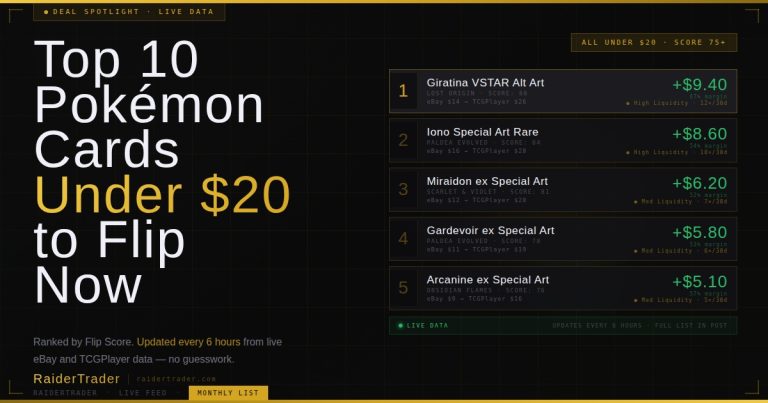
Every deal that qualifies gets a Flip Score from 0 to 100 based on the same inputs we’ve been talking about: net margin after fees, 30-day sell velocity, price trend direction, and seller reliability. Only deals that score 70 or above appear in the feed.
You open the feed and the research is already done. You look at the numbers, decide if it fits your budget and risk tolerance, and act. The free tier shows you the top three deals from each scan. Pro members see the full feed — every qualifying deal, filtered and sorted however you want, for $9 a month.
But even if you never sign up for anything, the manual process above is real and it works. Use it.
The Discipline Is the Edge
The thing that separates consistent flippers from people who occasionally get lucky is simple: they check the same data points every single time. They don’t skip the sell velocity check when they’re in a hurry. They don’t round up their margin estimate when the card looks exciting.
The gap between eBay casual sellers and TCGPlayer market prices isn’t going away. It exists because of how people sell — and most people will always sell by feel rather than by data. That gap is yours to take, as long as you stay disciplined about checking the numbers before you buy.
Start with one card. Run the full process. See what the numbers actually say. Then do it again.
Qualifying Deals
The RaiderTrader feed updates every 6 hours. Every deal shown has already passed the margin, liquidity, and trend checks.
View Live Deals → Free tier available · Pro from $9/month · No credit card to start