
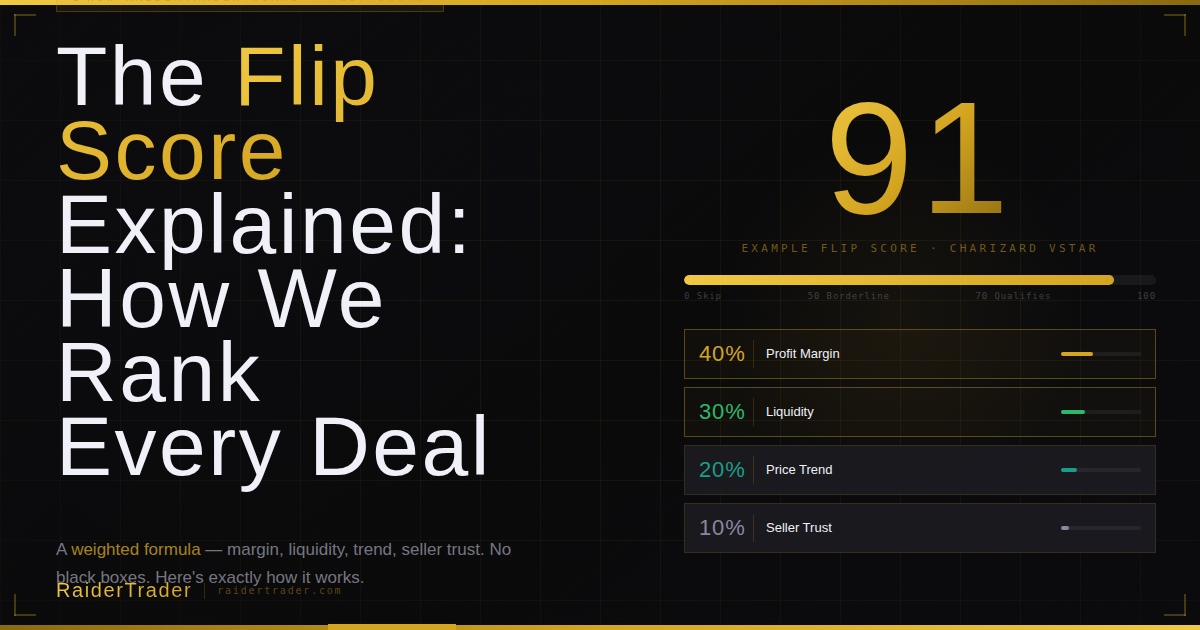
When you open the RaiderTrader deals feed, every listing has a number next to it — a Flip Score from 0 to 100. We only surface deals with a score of 70 or above. That number isn’t a gut feeling or a price alert. It’s a weighted formula that accounts for four things simultaneously: how much you stand to make, how fast the card actually sells, which direction the price is moving, and how reliable the seller is.
This post breaks down each component in full. No black boxes. If you’re going to act on a score, you should understand what it’s telling you.
A score of 91 is about as strong as deals get on the platform. Let’s walk through exactly why a deal earns a number like that — and what would lower it.
The Four-Component Formula
The Flip Score combines four inputs, each weighted differently based on how predictive we’ve found them to be for a successful flip:
Component 1: Profit Margin (40%)
Margin is the largest single input because it’s the most direct measure of whether a deal is worth your time. But we don’t just look at the raw price gap between eBay and TCGPlayer — we calculate the net margin after fees on both ends.
eBay takes roughly 13% on a sold card (final value fee + payment processing). TCGPlayer takes approximately 10% when you list there. That means a card listed at $27 on eBay and priced at $49.40 on TCGPlayer doesn’t yield $22.40 in profit — it yields closer to $18–19 once both platforms take their cut. This can be checked manually on ebay itself.
We score margin on a curve: 20% net = qualifies, 30% = good, 40%+ = strong. Margins above 50% contribute maximum points to this component. Anything below 15% after fees fails to qualify regardless of other scores.
This is why the feed doesn’t show you every eBay listing that’s cheaper than TCGPlayer — it only shows deals where the net margin justifies the effort after both platforms take their cut.
Component 2: Liquidity (30%)
Liquidity is the second-largest input and, in our experience, the most underappreciated one. A card with a 50% margin that sells twice a month is a worse flip than a card with a 25% margin that sells every two days. Capital that’s tied up in a slow card is capital you can’t redeploy.
A 40% margin on an illiquid card is worse than 25% on a liquid one. The score reflects this — liquidity can suppress or amplify everything else.
We pull 30-day sold data from eBay for each card and calculate a velocity score. Our tiers:
Component 3: Price Trend (20%)
Price trend answers one question: is this card’s TCGPlayer market price going up, staying flat, or coming down over the last 14 days?
An upward trend is a tailwind — the gap you’re buying into today may be even wider by the time you list. A downward trend is a headwind — the card might be worth less than the TCGPlayer market price shows by the time you list it. A falling market can turn a good margin into a breakeven or a loss within a week.
Rising 5%+ in 14 days = full points. Flat (±2%) = partial points. Falling = zero points for this component, and a flag is shown on the deal card. A strong downtrend can prevent a deal from qualifying regardless of its margin.
This is also why you’ll sometimes see deals disappear from the feed between scans — if a card’s price drops sharply after a listing goes live, it can fall below a 70 score and get removed until the listing or price normalizes.
Component 4: Seller Trust (10%)
Seller trust is the smallest component but serves as a hard filter. A deal that looks perfect on paper is worthless if the seller delivers a damaged card, the wrong card, or nothing at all.
We evaluate each eBay seller on three things: feedback score (we require 98%+), total transactions (minimum 50 completed sales), and category history (do they have a history of selling Pokémon cards specifically, or is this a one-off listing from a general seller?)
Sellers who fail the minimum threshold are excluded from the feed entirely. Sellers who meet minimums but have thinner history score fewer points in this component, which can pull a borderline deal below the 70 qualifying score.
Putting It Together: A Real Deal Breakdown
Here’s how the Charizard VSTAR deal from the top of this post actually scores:
Common Questions
in Action
The live deals feed updates every 6 hours. Pro members see every qualifying deal — filtered, sorted, and ready to act on.
View Live Deals → Pro from $9/month · Free tier available