
Here is a mistake that costs new flippers real money: they buy a card on eBay listed as Near Mint, it arrives Lightly Played, and when they go to list it on TCGPlayer the margin they planned on has disappeared. Not because the price moved. Because the condition did.
Card condition is a pricing variable, not just a quality label. A Charizard VSTAR that is Near Mint trades at $49. The same card in Lightly Played condition trades at around $36. That is a $13 difference — more than half your margin on a deal that looked clean when you bought it.
This guide covers every condition grade, what actually separates them in practice, how to read eBay listings accurately, and how condition affects your flip math. If you are buying cards to resell, this is worth knowing before you spend money on a deal.
Why Condition Matters More for Flipping Than Collecting
Collectors have some flexibility on condition. If you love Umbreon and want it in your binder, LP is fine — it still looks great in a sleeve. But when you are flipping, you are not buying for enjoyment. You are buying an asset with a target sell price, and that sell price is directly tied to the grade.
TCGPlayer prices every card by condition separately. Near Mint and Lightly Played are not the same product. They are listed in different inventory pools, they attract different buyers, and they move at different speeds. An LP copy of a popular card will always sell slower than the NM version because serious buyers — the ones who move quickly — almost always filter to NM first.
When you buy LP thinking it is NM, you do not just lose margin. You lose sell velocity too. The card takes longer to exit, and ties up your capital while it waits.
This is why condition accuracy matters so much when you are evaluating a deal. You need to know exactly what you are buying — not what the title says, but what the photos actually show.
The Five Condition Grades — What They Actually Mean
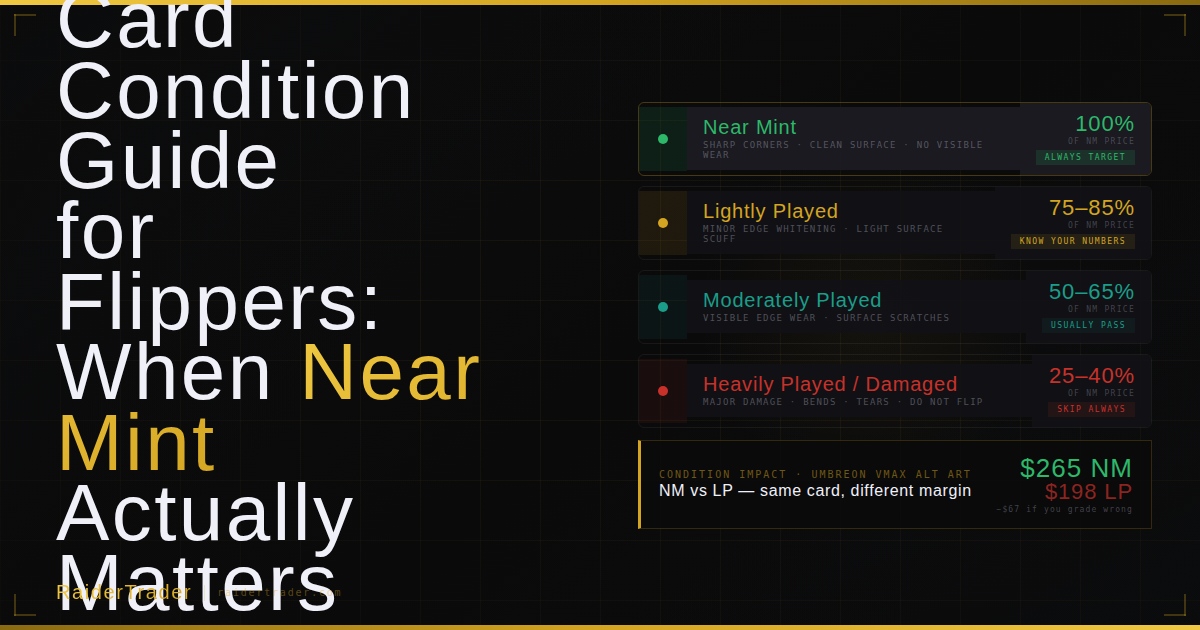
TCGPlayer and most of the Pokemon TCG market use five standard condition grades. Here is what each one means in practice, not just on paper.
Near Mint (NM)
The gold standard for flipping. Near Mint means the card shows no visible wear under normal viewing conditions. The corners are sharp. The surface has no scratches. The edges are clean with no whitening. There may be very slight imperfections from factory handling — a faint print line, a tiny nick invisible without close inspection — but nothing a buyer would notice or complain about.
Always target NM when you are flipping. NM sells fastest, benchmarks to the highest market price, and gives you the most buyer confidence. If you are unsure whether a card is NM or LP, price it as LP in your margin calculation. Being wrong in that direction costs you nothing. Being wrong the other way costs you the deal.
Lightly Played (LP)
This is where most condition disputes happen. LP cards have minor visible wear — light edge whitening, a small scuff on the surface, or corner wear that is visible up close but not immediately obvious. The card still looks good sleeved and played, but it is clearly not pack-fresh.
On eBay, a lot of cards are listed as Near Mint that are actually Lightly Played. Sellers frequently overgrade. This is one of the most common ways new flippers get burned — they plan their margin around NM prices and receive an LP card.
Moderately Played (MP)
Noticeable wear that is visible at a glance. Whitened corners, edge wear around the full border, surface scratches that catch light, or minor creasing. The card is still structurally intact but clearly used. For flipping purposes, MP is almost always a pass. The market price discount is severe enough — often 40 to 50% below NM — that the margin math rarely works, and sell velocity on MP copies of high-value cards is very slow.
Heavily Played (HP) and Damaged (D)
HP cards have significant wear — deep scratches, major edge and corner damage, heavy whitening, or bends. Damaged means the card has a tear, structural crease, water damage, or writing on it. Do not flip these. If you accidentally receive HP or Damaged when you expected NM, open an eBay dispute immediately — misrepresented condition is a valid return reason covered by eBay buyer protection.
How to Read eBay Condition Claims Accurately
eBay sellers self-report condition. There is no third-party verification, no standard grading process, and no consequence for overgrading other than a return request after the card arrives. That means you have to assess condition yourself from the photos before you buy.
-
1Check the corners under direct lightCorner wear shows up as white fraying at the tips. NM corners are sharp and fully coloured. If any corner shows whitening — even one — the card is at best LP. Look for angled photos, not straight-on shots which hide corner wear.
-
2Look at the edges under lightEdge whitening runs along the card border. NM edges are crisp and fully coloured. A fine white line along even one edge means LP. Heavy whitening on multiple edges means MP. Easier to spot in angled photos.
-
3Check the front surface for scratchesSurface scratches catch light and show as fine lines across the artwork or foil. Ask for an angled light-source photo if the listing only has straight-on shots. Foil cards scratch more visibly — be extra careful with Alt Arts and SIRs.
-
4Check the back for scuffs and print linesThe back often shows wear the front hides. Scuff marks or scratches on the back affect the grade even if the front looks perfect. Ask for a back photo before buying on a high-value card if one is not included.
-
5Watch for red flags in the listing languagePhrases like “looks NM to me,” “minor imperfections,” or “great for play” signal LP or below. Dim lighting, blurry close-ups, or only straight-on angles usually mean the seller is hiding wear. NM cards are easy to photograph clearly — if the photos are unclear, there is usually a reason.
When evaluating an eBay listing from an unknown seller, assume the condition is one tier below what is listed. If they say NM, budget as if it is LP. If the card arrives NM, great — you have extra margin. If it arrives LP, your flip math already worked at that grade. This single habit will save you from bad deals consistently.
Condition and Sell Velocity — The Overlooked Connection
Price is not the only thing that changes with condition. How fast a card sells changes too — and for flipping, that matters just as much.
The buyers who move fastest on high-value cards are collectors who filter to NM and have price alerts set. They act within hours. LP buyers are more price-sensitive, more patient, and fewer in number. An LP Charizard VSTAR at a fair LP price might sit for two weeks where an NM copy would sell in two days.
What About PSA and BGS Graded Cards?
Professionally graded cards — slabbed by PSA, BGS, or CGC — are a different market entirely. A PSA 10 Charizard VSTAR is not the same product as an NM raw copy. It sells in a different pool, to different buyers, on different timelines, at dramatically higher prices.
Graded cards can be flipped profitably, but the mechanics are completely different. You need to account for grading fees ($25 to $150+ per card depending on service tier), turnaround time (months in some cases), and the uncertainty of what grade you will receive. A card you buy raw expecting a PSA 10 might come back a 9 or an 8, which can mean it is worth less graded than raw.
The RaiderTrader deal feed focuses on raw card arbitrage — eBay raw listings versus TCGPlayer raw market prices. If you are newer to flipping, start with raw NM cards and understand that market first before adding graded cards to the mix.
When LP Cards Are Actually Worth Buying
LP is not automatically a pass. There are situations where buying LP makes sense — you just need to run the numbers at LP prices, not NM prices.
LP works when the eBay listing price is deeply discounted relative to TCGPlayer LP market price specifically. If a card is listed at $40 on eBay, TCGPlayer NM is $100, and TCGPlayer LP is $75 — that is still a 47% margin on the LP benchmark. The mistake is calculating against NM when you know the card is LP.
LP also works more reliably on lower-value cards where the absolute price difference between conditions is small. A card where NM is $12 and LP is $9 carries less condition risk than one where NM is $180 and LP is $135. The margin loss from a condition downgrade is proportionally more damaging on expensive cards.
Common Questions
Qualifying Deals
The RaiderTrader feed pulls live eBay listings and benchmarks them to TCGPlayer Near Mint market price. The hard work is done before you open the page.
View Live Deals Free tier available · Pro from $9/month · No credit card to start