
Most people define a good flip the same way: buy low, sell high. And that’s not wrong — but it’s incomplete. A card that sells for 40% over what you paid sounds great until it takes four months to find a buyer. A card with thin margin that moves in three days might make you more money by the end of the month than a “great” margin card that sits on your shelf.
A genuinely good flip has three things working for it at the same time: profit (the margin after all fees), liquidity (how fast you can actually exit), and risk (how likely the price is to move against you before you sell). Miss any one of those and the flip gets harder than it looks on paper.
This post breaks down each pillar — what it means, how to measure it, and how RaiderTrader’s Flip Score weighs all three automatically so you don’t have to run the math yourself every time.
Pillar 1: Profit — The Margin That Actually Matters
Margin is the starting point, but the number most people use is wrong. They look at the difference between what they paid and what a card is listed for. That’s not your margin. Your margin is what’s left after the platform takes its cut.
How to Calculate Real Net Margin
Start with the TCGPlayer market price — not the lowest listing, which is often an outlier. That market price is your realistic selling price. Then subtract what you paid on eBay. Then subtract selling fees.
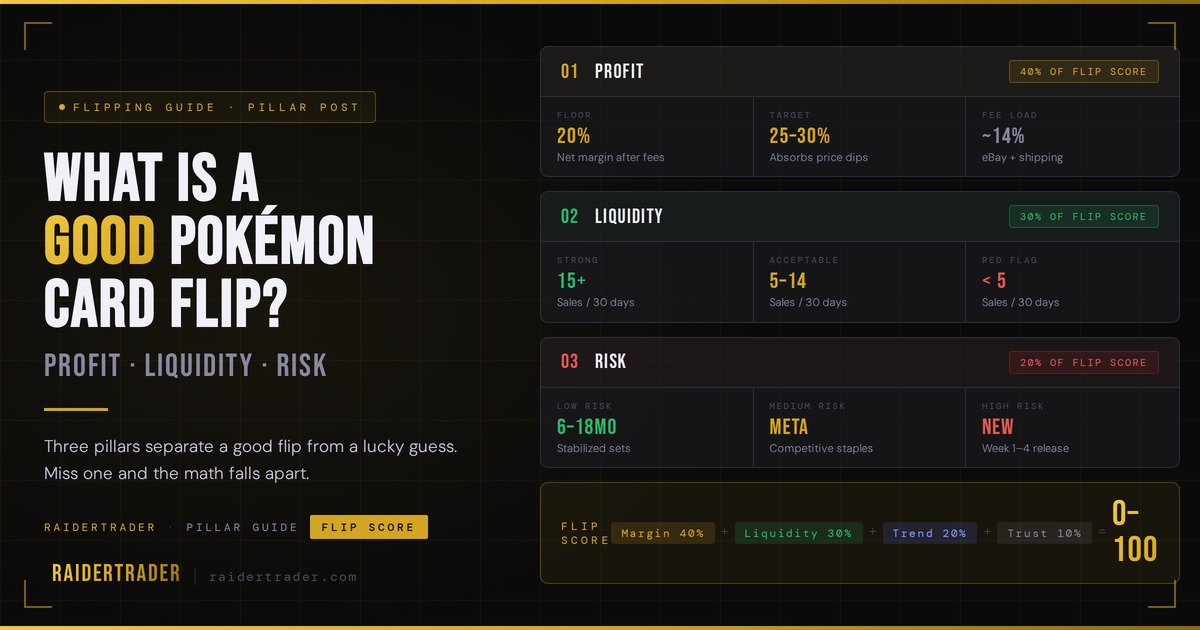
The fee load on most eBay-to-TCGPlayer flips runs 13–15% of the selling price. On lower-dollar cards where shipping is a bigger percentage, it can push to 18–20%. This is the number that kills deals that look good at first glance.
Below 20% net margin, you’re working hard for a return that won’t survive a $5 price dip or a slow-moving month. Target 25–30%+ net on most flips. On higher-dollar cards where even 15% is real money, you can adjust — but know what you’re accepting.
Pillar 2: Liquidity — How Fast Can You Actually Exit?
This is the pillar most new flippers skip, and it’s the one that turns “good flip” into “money stuck in a binder for three months.”
Liquidity, in this context, means one thing: how many times has this card sold in the last 30 days? That number tells you how fast you can expect to find a buyer after you list it. A card with 20 recent sales will move in days. A card with 2 recent sales might sit for weeks.
Why Liquidity Beats Margin on a Cash-Flow Basis
Here’s the math that makes this real. Say you have $500 to work with.
The “worse” margin card compounded into nearly 8x more monthly profit because the same $500 cycled through multiple times. Cash velocity beats paper margin every time.
A 40% margin card that takes 90 days to sell is worse than a 22% margin card that turns in a week. Cash velocity beats paper margin.
Liquidity Benchmarks
-
✓
15+ sales / 30 days — highly liquid. Expect to exit in under a week after listing. -
~
5–14 sales / 30 days — acceptable. Plan for 1–3 weeks. Factor that time into your decision. -
✗
Under 5 sales / 30 days — illiquid. Unless the margin is exceptional and you can afford to wait, pass.
Pillar 3: Risk — Will the Price Hold While You’re Holding It?
Even a flip with great margin and solid liquidity can go wrong if the price drops before you sell. This is the risk pillar — and it’s the one that’s hardest to measure because it requires understanding why a card is priced the way it is right now.
Price Trend Direction
The simplest risk check: is this card trending up, flat, or down over the last 30–60 days? A card that’s been climbing 10% month over month is a safer hold than one that’s been sliding. You’re not trying to time the market — you’re just confirming the floor isn’t falling out.
The Four Risk Categories
The safest flips sit in the bottom two rows. Sets from 6–18 months ago hit the sweet spot: prices have stabilized, reprint risk is mostly already priced in, and they still have enough active demand to move quickly.
How the Flip Score Weighs All Three
This is exactly what RaiderTrader’s Flip Score does — it takes margin, liquidity, and risk and compresses them into a single 0–100 number for every qualifying eBay listing, updated every six hours.
The weighting reflects how much each pillar actually matters to outcomes:
A deal that scores 85+ is typically a card with 28%+ net margin, 12+ recent sales, a flat-to-rising price trend, and a seller with solid feedback. A deal that scores 65 and gets filtered out is usually one where the margin looks fine but the card barely traded in the last month — exactly the kind of trap the liquidity pillar is designed to catch.
What a Good Flip Actually Looks Like
Put the three pillars together and a “good flip” has a clear profile: a card from a set that’s 6–18 months old, with 25%+ net margin after fees, 10+ recent sales, and a price trend that’s flat or rising. It’s not exciting. It’s not a chase card from a new set. It’s a reliable, repeatable gap between what a casual eBay seller listed and what the TCGPlayer market will pay — and there are dozens of them every week if you know where to look — and if you need a starting point, our list of underrated pokemon cards worth watching is a good place to begin
The discipline is running all three checks every time, not just on the ones that look exciting. Most flips that go wrong fail on one of these three things — and usually it’s the one the buyer skipped because the margin looked so good they didn’t want to look too hard at the rest.
Scored Deals
Every listing in the RaiderTrader feed has already been scored on margin, liquidity, trend, and seller trust. Only deals above 70 make the cut.
View Live Deals →
Free tier available · Pro from $9/month · No credit card to start