How to Evaluate a Pokémon Card Flip in Under 60 Seconds
You’re scrolling eBay, half paying attention, and a listing catches your eye. A graded Charizard, a weird-looking modern alt art, a sealed booster box at a price that seems off. You’ve got maybe a minute before the tab gets buried under twelve others. So how do you actually decide — flip it, or scroll past? […]

You’re scrolling eBay, half paying attention, and a listing catches your eye. A graded Charizard, a weird-looking modern alt art, a sealed booster box at a price that seems off. You’ve got maybe a minute before the tab gets buried under twelve others. So how do you actually decide — flip it, or scroll past?
Here’s the checklist the fastest flippers run through, in order, every single time. None of it requires a spreadsheet. Most of it can happen while the listing is still loading.
The 60-Second Checklist
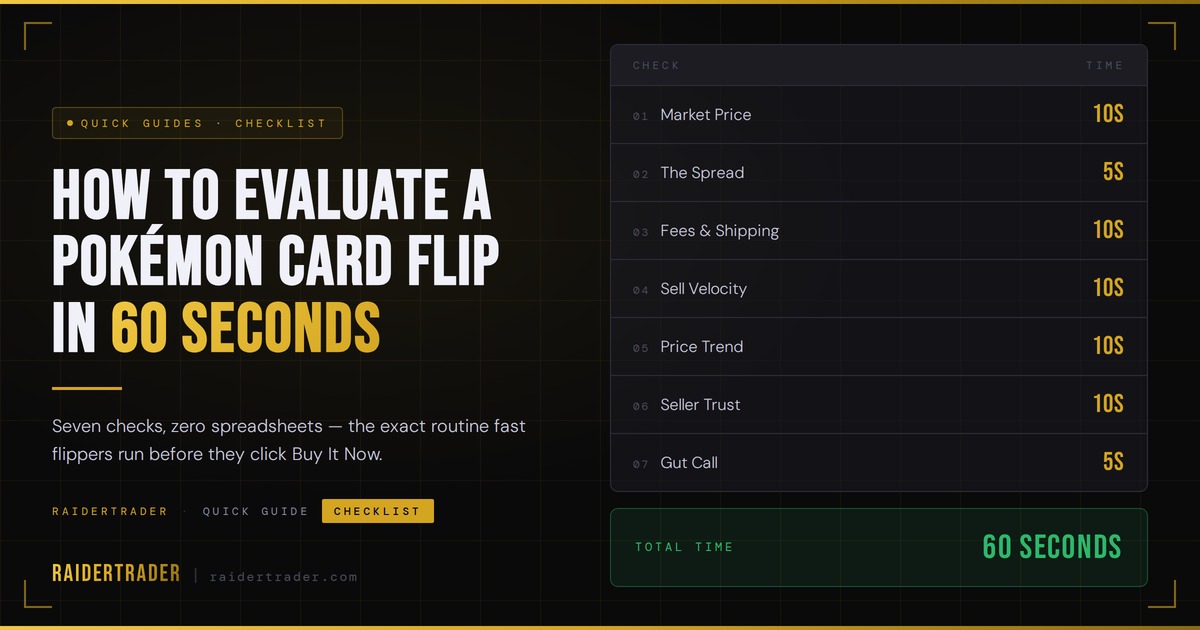
Seven checks. Sixty seconds. Run them in order — if a listing fails early, you can bail before you’ve spent your whole minute on it.
-
1What’s the actual market price? — 10 secDon’t trust the listing price, the “rare!!” in the title, or the seller’s idea of value. Pull up the card’s TCGPlayer market price or recent sold comps. That number — not the asking price — is your anchor for everything else.
-
2What’s the spread? — 5 secSubtract the listing price from the market price. That’s your gross margin before anything else. As a rough rule, anything under a 20% spread usually isn’t worth the time it takes to list, pack, and ship.
-
3What will fees and shipping actually cost you? — 10 secThis is the step impulse buyers skip — and it’s the one that turns “great flip” into “broke even.” Between marketplace fees, payment processing, and shipping, you’re often looking at 13–15% off the top, sometimes more on lower-priced cards.
-
4Does this card actually sell? — 10 secA 40% margin means nothing if the card sits for four months. Glance at how many copies have sold in the last 30–60 days. A dozen recent sales is liquid. One sale three months ago is a gamble dressed up as a deal.
-
5Which direction is the price moving? — 10 secTrending up means your margin might widen while you hold it. Trending down means today’s “deal” could just be the listing catching up to a falling market — not an underpriced card at all.
-
6Who are you buying from? — 10 secCheck seller feedback. A long history of positive ratings means the card is probably as described and will ship fast. A brand-new account selling “mint” for well under market isn’t always a scam — but it’s a reason to shrink your margin expectations, not your skepticism.
-
7Final gut call — 5 secMargin, fees, liquidity, trend, seller trust. If four or five line up in your favor, buy it. If only one or two do, let it go — there will be another listing in twenty minutes.
Quick Math: A Real Example
Here’s what running the checklist actually looks like on a real listing.
Three Red Flags That Save You a Click
Sometimes the fastest answer is “no” — and these are the patterns that let you bail before you’ve spent your full sixty seconds.
-
✗
Zero feedback + way under market. A brand-new account selling a “mint” card at half price isn’t automatically a scam — but combined with stock photos or a vague description, it’s usually a wrong-card listing, a damaged copy, or worse. -
✗
The price is trending down hard. If the card has dropped 15–20% over the last month, today’s “underpriced” listing might just be the market catching down to it — not a real gap. -
✗
Fewer than 3 sales in 30 days. The margin doesn’t matter if your money is locked up for two months waiting for a buyer.
If four or five checks line up in your favor, buy it. If only one or two do, let it go — there’s another listing in twenty minutes.
The Shortcut Version
If that felt like a lot to run through in 60 seconds — it is, when you’re doing it manually for every listing that crosses your feed. That’s the entire reason RaiderTrader exists.
Every listing it surfaces already has the market price, the margin after fees, the 30-day liquidity, the price trend, and seller trust rolled into a single Flip Score from 0–100. Instead of running this checklist yourself sixty times a day, you get the answer before you even click the listing — and you can spend your sixty seconds actually buying the good ones.
Do The Math
Every deal in the RaiderTrader feed already has the market price, margin, liquidity, trend, and seller trust baked into one number from 0–100.
View Live Deals →
Free tier available · Pro from $9/month · No credit card to start